Friday, January 4, 2019

Routines, Anchor charts & Stations, oh my!

As an Elementary Math Program Coordinator, I get the privilege of visiting campuses twice a week in hopes to keep in touch with teachers (gather constructive feedback for curriculum decisions) and engage with students (to better understand how they’re learning). Upon one particular visit, I ran into a teacher who asked if she could pull me aside and into her classroom to ask about the different visuals used to teach dividing unit fractions by a whole number and dividing whole number by unit fractions.

I got goosebumps by the sheer question and personal desire this teacher had to move students from a conceptual understanding to an abstract knowledge of the algorithm associated with this concept. She urged me to watch her draw each model, encouraging me to correct her whenever I saw her deviate from the appropriate strategic approach. After she flawlessly modeled each strategy, we discussed how the process connects to contextual situations and how important it was for students to interpret the difference between each model. *for clarity, watch this video!


It was through this discussion that she began to explain to me the daily learning routine she takes her students through, that allows them to excel despite their daily hurdles of (shortened instructional time, highly disruptive behavior problems and students with tremendous gaps). 

Image result for learning with manipulatives

  • First, she does a quick mini-lesson by which she introduces the concept, and engages the students in the skill through manipulative exploration and/or drawings. 

  • Next, she involves the students in building an anchor chart together based on their new learning.

  • From there, she gives students time to complete a short, open ended formative assessment with the support of their notes and class-created anchor chart. 
  • While reviewing the formative assessment data, she has her students in stations and pull students to her small group table to work with them based on their formative feedback. 


My second case of goosebumps came over my arms as I sat in awe of this teachers’ fabulous Tier 1 routines. I also couldn’t help but get distracted by the images of her class-created anchor charts hanging on the wall like a museum of art (see above), the evidence of learning from historically low performing students who felt confident enough to complete their formative without the offered support of their teacher.

I can’t explain the way a math heart leaps with excitement when it witnesses non-numeric evidence of student learning. When historically low performing students, who CAN (although their data often says otherwise), show off their true abilities.

These elements, when evident in a class can tell a story about the teacher's classroom culture, the efficacy built into his/her students and exemplifies their instructional practices.

Needless to say, my day was made! Kudos to this teacher, for her students are truly blessed!

The Pedagogy of Digital Resources


Image result for laptops

It’s been my desire, for quite some time, to write a piece on digital resources.
Why? Because as I’ve grown to love the plethora of research that bring to light the true "math" in mathematics (see below)- I've come to learn the unique purpose that blending digital resources and true curriculum can have on students. 
  •  NCTM’s articles on Teaching Mathematics
  • John Van de Walle’s literature on Teaching Student Centered Mathematics
  • Jo Boaler’s series of the Mindset of Mathematics
Image result for reflex mathIts because of these articles (and books) that expound on the true meaning of mathematical concepts such as fluency, I’m compelled to believe our systems just aren’t designed with the integrity of this evidence in mind. 

Image result for abcyaI'll admit, I've been dragging my feet with speaking on this subject. After all, it wouldn’t make me the most popular person. For example...

I was sitting at a Hibachi Grill with a fellow educator friend, and two families (that I did not know). One family consisted of a couple that happened to be educators; while the other family consisted of a parent of two grade school students. The male spouse of the first family began a conversation about his intermediate class and how engaged his students are when they interact with a particular digital resource (that shall not be named). When he named the resource, the 2nd family chimed in putting their stamp of approval on the resource for the following reasons:
1. Because their students loved the gaming feature 
and
2. Their students "engagement" was based on the premise of point collection achieved by getting answers correct. 

I silently listened as they went back and forth rattling off academic digital resources that they perceived to be "engaging" their students. Then the time came when they turned to me for my opinion, expecting me to agree. I knew my response would not be liked so I turned my response into a question to dodge sharing my opinion. *keep reading for the question...

Image result for prodigy
Teachers pride themselves in searching and finding websites that engage their students and keep them entertained during Math; and I truly believe that teachers are our most valuable assets and clients. So how does one address a critically relevant topic without causing the user of the product some rub?

I preface this next piece with these two ideals in mind:
  • I intend on addressing my opinionated view from an educated vantage point; using literature and research to support my points.
  • I know that while my views won’t be popular, they can lead to some challenging conversations and hopefully encourage those with a growth mindset to be somewhat objective when considering the programs you value and enjoy.

So, here are my (2) questions (one of which was asked at the hibachi table): 
  • “What is your favorite digital resource for students to use in your classroom?”
  • Why is it your favorite?

Image result for ixl 
Now, you don't have to leave your answers in the comments, but check out the responses below and silently nod if yours match any of these.
  • student engagement 
  • ability for students to feel their learning is personalized
  • excitement of a product’s gaming features 
  • student’s ability to build an emoji or collect coins 

So why did I dodge the question that evening at dinner? Because in order to support rich learning, best initial instruction practices and promote true success and growth in students, our digital products must mirror the rigorous and conceptual components of our Tier 1 instruction. 

You might be asking, "what are those practices?" and "does my favorite product embody them?"

Image result for stride academyWell I'm certain the practices I'm about to share are NOT ones that pique the interest of a student willing to engage in a computer created product! Nor are these pedagogical practices the primary selling point of programs that (upon consideration) make a teacher believe students will stay "engaged" and "out of their hair (quiet)" while we tend to the other classroom duties. After all, were you ever like me and at times needed at least 5 of my students to be so engaged on the computer that they would not want to bother me while I worked with students at my horseshoe table? I'm not saying it's right, but its what teachers secretly hope for. 

If so, consider this...

The Pedagogy of Digital Resources.

Here are my top 4:

  • True fluency – Fluency is NOT a students capability to rattle off facts quickly (somehow demonstrating a pseudo-knowledge of those facts). Fluency is, however, strategies that support flexibility with numbers (different approaches to the same answer); a focus on accuracy, all leading to the notion of true automaticity. My opinion is that Digital resources should provide THIS level of fluency through pictorial manipulation of strategic tools (ten frames, rekenreks, area models, number lines, etc) building towards patterns in sums and products that eventually lead to accuracy and time.

  • High Cognitive Demand- not a focus on answering questions, but a focus on prompts that cause the student to ask the questions. Sometimes a simple visual with a focus on analyzing and interpreting the visual causes students to move from finding an answer (numeric) to higher order thinking and processing skills such as justifying, reasoning and explaining! 

  • Instructional Alignment & Support- While I understand that Texas is the rogue state (by choosing to adopt their own set of standards, rather than the Common Core); I fully support our new mathematical standards and the learning progression they provide, as well as the level of thinking and learning they imply. Our standards beautifully embed the “math” in mathematics with explicit emphasis on strategies that support learning (number lines, strip diagrams, arrays, area models, properties of operation, mental math, etc). All things that were missing in math when we were growing up; and all things that truly support development of the CRA (concrete to representational to abstract) thinking process students need to bridge their learning and develop a sound foundation. Resources that embed these strategies support the learning that occurs in the classroom by coming alongside what we as teachers are (should be) doing to keep in step with the TEKS and giving an additional layer of support when students are working with us, or with other students in a hands-on way. Whether a child chooses this or not, this option should be provided. This process simulates the learning/instruction cycle that should be evident in math classrooms. Students should be given an opportunity to engage in learning that aligns to the standards, directly (not in part). Meaning through some short video or manipulation simulator, or quick snapshot of visuals, given a chance to make connections to algorithmic/abstract concepts. This is truly supporting the instructional cycle as it embodies remediation, enrichment and extension!

  • Engagement- This final component is easily the most sought after piece yet, I would contend, can also serve as the largest instructional distractor. Seeking after engagement as a primary characteristic of an instructional digital resources is a distraction if not coupled with intentional focus on learning by manipulating math models. 

I've got to admit, with the plethora of math instructional resources I've dabbled in, not many have blown me away! Perhaps one day I'll get the opportunity to work on developing such a product! Either way, here's my point. If a digital resource only provides engagement to students and that's the most valuable component, we are failing our students in light of instruction. And likewise, if a digital resource that is expected to support instruction ONLY provides students the opportunity to answer various questions, then it's a digital worksheet or constant digital assessment of the student, at best! It's not a "Curriculum" based resource. I can't even say that's a supplement to instruction. 

I believe that Instructional Digital Resources should possess the ability to engage students while taking them through a highly cognitive, aligned instructional progression (including contextual problems), and provide opportunities for them to explore the multifaceted components of fluency while asking the questions that math provoke. 

So like I said, it's not the popular answer, but my experiences with various levels of student ability coupled with an extensive study of mathematics instruction have led me to these conclusions. 

Thursday, August 9, 2018

The Mis-education of Comparison Anchor Charts -


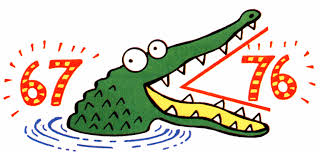
Image result for alligator comparisonIn my quest for sample Comparison Anchor Charts to add to our curriculum documents (you know that phrase, "work smarter, not harder"), I must admit I was overcome with sadness when I spent minutes scrolling Google images (and Pinterest) only to find alligator-themed posters over and over again. So I decided it would be my joy to support educators in embracing more sound practices that support the MATH for students.

Image result for connect the dots comparison symbolsAlthough I've never been a fan of the "alligator" comparison symbols (I was a connect-the dots girl- *see below); it doesn't matter...a trick is a trick. A trick is NOT math. So, over the years, I've invested in studying the mathematical research behind the concept of comparing numbers.
Why is this concept - COMPARISON- so difficult for students?

A 5th grader (quite proficient in math) approached me for help because she failed her STAAR test by 1 question. When I poured over her data/answer choices released by the state, I realized she only had minor mechanical/computational errors (chosen answer choices meant to highlight those misconceptions). But then I asked her to tell me the story that data DOESN'T often tell. Her response was,

"I just don't get which way the comparison symbols go when trying to indicate which decimal number is larger."

Stunned that a student who has been comparing since Kindergarten was about to enter Intermediate school with this misconception, I was compelled to be the one who changed "the game" for her! Quickly, I sketched an open number line on a scratch sheet of paper much like the one below- end arrows and all.
Image result for open number line
        < (less than)                                                     (greater than) >
                                     
I gave her two whole number and asked her to point out where they would go. Then I increased the value of those numbers by 100 and again by 10,000 until I finally asked her what did she notice about the smaller numbers and the larger numbers. To which she responded that numbers with smaller value lean more towards "this end" of the number line and larger numbers towards the other end. I shared with her that the arrows on those respective ends indicate the appropriate comparison symbols.

So 3 < 4 because 4 contains the value of 3 (note to teachers: also called magnitude of numbers and hierarchical inclusion). But more cool than that is that the 3 is close to the "<" arrow. And likewise, 4 > 3 with 4 being closer to the ">" arrow; so essentially I can record both number sentences and be accurate in my statement. Her mind was BLOWN!
You see, the number line isn't a trick, it's a strategy that helps students understand the magnitude of a number in relation to another number.


So if a 5th grader who excelled in math, still misunderstood the comparison symbols is it safe to say that its possible somewhere along her math exploration journey, she learned the symbols (through some cute alligator-like, kid friendly method) or prematurely? Perhaps her exposure to the symbols was justified by the notion that she was "capable" of understanding or "ready" for it.

Can I submit to you, however, that a change is badly needed? 

With that being said, I'd like to share grade appropriate anchor charts with each approach that include research based strategies and TEKS-aligned pedagogy. *Keep in mind anchor charts are built WITH your students, so these are pictorial BIG ideas to help guide your lesson approach so when its closure time and your students are brain dumping from their lessons and station exploration, the results should look similar to these pictures.

Kinder and 1st grade teachers: (Concrete) Provide your kiddos with a colossal number of opportunities to build two numbers (use (FUN) counters, linking cubes, ten frames, rekenreks, etc) and sentence stems to orally express which is greater and why. Don't forget to model sharing "which is fewer/less" as well.
Image result for teaching student centered math"..the word less proves to be more difficult for children than the word more. To help children with the concept of less, frequently pair it with more and make a conscious effort to as "Which is less?" as well as "Which is more" questions."
~Teaching Student Centered Math K-2
(John Van DeWalle)


BOY Kinder (to 10) Day 1 example
BOY Kinder (to 10) Day 2 example
BOY Kinder (to 10) Day 3 example


BOY Kinder (to 10) Day 4 example

BOY Kinder (to 10) Day 5 example with both comparison statements paired
So you'll see how each anchor chart "pairs" comparison sentences as an example of a conscious effort on a teachers' part to pull this out of students through exploration.


1st and 2nd grade teachers: (Concrete/Pictorial) Provide your kiddos with an appropriate number of opportunities to build two numbers (use ten frames, beaded number lines, linking cubes, base ten blocks, etc) and sentence frames coupled with symbols to express which is greater and justify why using number lines.

*BOY 1st Grade Whole Numbers (to 20)

2nd and 3rd grade teachers: (Pictorial/Abstract) Provide your kiddos with a model of how to use number lines (annotated and open) as a pictorial model followed by expanded form (and notation) to compare numbers as a more abstract scaffold.

         
2nd Grade Whole Numbers (to 1,200)
3rd Grade Fractions (with like numerators)

4th and 5th grade teachers: (Pictorial/Abstract) Your approach shouldn't differ much from 2nd and 3rd, but starting over with a concrete approach as you bring in decimal models (via money models, base ten blocks, grids, and number lines) as well as fraction models (towers and tiles) would be ideal.

4th (and part of 5th) grade decimals

Image result for nix the tricksAs one of my favorite bloggers and practitioners (Math Coach's Corner- Donna Boucher) would say, "There are no swamps (and thus no alligators) in Math!"

Let's ensure our practices reflect the MATH rather than the TRICKS!

Nix the Tricks Free eBook: Download the book here