For years, this whole notion of "Will over Skill" has been a controversial topic of discussion in the education sector. I remember listening in on my very first conversation around this matter- those locked into the discussion were passionately sharing their justifications behind their points of view.
One argued for the issue of will over skill, by stating that hiring teachers who have the will to learn is much more profitable in the long run than holding out to wait for a teacher who has the skill and may not be available for hire at the time of need. After all, due to the will of the teacher readily available, he or she might end up being more loyal (less likely to leave) and mold-able to the point of having the same level of skill as the skillful teacher, in years to come!
The other argued for the issue of skill over will, by refuting those statements with their own ideals. Their vantage point was predicated on the premise that a skillful teacher will not only bring their experience and knowledge to the table, but also the same (if not more) "will" of the will-only teacher. Not only that, the skill-grounded teacher would produce greater results quicker than the will-based teacher.
While I can see the validity in both arguments; and while it's quite possible that I, at one point, may have benefited from being hired because of my will more so than my skill (right out of college, and when transitioning from the classroom to an instructional leadership position), I have a hard time saying that one approach is the only way to go.
For example, every teacher who has been given leadership experience, and received their Admin certification deserves a chance to at some point be chosen as an AP. Not every interviewed AP needs to have had previous experience as such. But even in a "will over skill" situation like this, it's poignant to understand that such a candidate should be acknowledged for the volume of leadership experience (thus skill) they are bringing to the table. This same ideal could be applied to teachers leaving a certification program (having had time with a mentor teacher in a student-teacher experience); as well as a to an educator moving into some other type of leadership position. Some consideration of experience (skill) should be taken into account and thoroughly scrutinized prior to hiring. I spoke with a friend recently, and she told me about a rigorous interviewing 3-step process she endured and how mentally exhausting it was as she wondered whether or not she would be chosen despite her extensive experience and skill.
The first step was an in-depth interview with content experts, asking deep questions around her knowledge of the TEKS, her abilities to traverse the ins and outs of curriculum research. She said, as a curriculum minded person, it impressed her that the department cared so much about her background knowledge as to screen her in this way.
The second step included her sitting in front of a board of leaders of various kinds (Execs, Admin, Superintendents, etc) inquiring about leadership scenarios and support. The final step in the process was a performance task, where she was ushered into a room that held the current department plan on the wall. She was asked to critique it and provide solutions to any holes or gaps she found. As I sat and listened, I was highly impressed. This is the type of process that weed outs those with limited skill and an overabundance of will, but allows for those with an equal measure of skill and will through.
On the other side of the coin, there are certain situations & positions, (I believe) that require an equal amount of skill and will or possibly a bit more will than skill but nonetheless a considerable amount of skill. Certain leadership positions that require one to serve as a leader over others in that area, leading the charge with various tasks related directly to the knowledge and skills needed in that area; well I have a hard time seeing a person with more will than skill leading such a charge. It can be very stressful for those who serve under such a leader, to not only respect said leader but also to endure working on projects, getting critical decisions made, etc when that leader is operating predominantly off of will. When that leader has no sound knowledge or concrete experience (good and bad) to build off of, it could be detrimental to those who are directly (and indirectly) impacted by their leadership. Take for example an educator who gets chosen to serve in an Executive position leading other Administrators, but has had no administrative experience of their own (sound absurd right?) yet has had various other leadership positions and perhaps has even worked alongside other Administrators might exemplify the will to serve in this position; to learn from various professional learning situations and perhaps even befriends several administrators to learn from them (on the job). How might this new Exec provide the mentor-like encouragement, the sound advice that has worked in their favor (or even has failed them) when a new Administrator seeks out advice?
Again, I understand the notion of both view points, but I am more inclined to take skill over will than will over skill; or at least if I did have to hire someone with will over skill, I'd be looking for someone with a considerable balance of the two with the ability to pass through a rigorous screening process. I've seen a lot of nepotism and favoritism in education in the area of hiring practices. I've tried to determine which is more detrimental to a system centered around students and I've come to find them both somewhat equally deplorable and disrespectful to the skilled staff that serve under such hired leaders as well as to the students we (in education) claim to "do it" for! At the end of the day, such hiring practices are much more self-serving than others focused! With the fact that education receives the catfish of salaries, the short end of the stick from government in terms of support and funding and yet demands the most hours and effort - it saddens me how political and not-about-kids it can become when leaders are put in a position to hire. We should be more cognizant of these practices by tightening up the hiring process and doing everything we can to develop and build proper culture to retain our skilled teachers, administrator and leadership staff, to reduce the possibility of being placed in such predicaments. Let's get behind the notion of skill over will so we can show students we value their education and those in the corporate world that we take our profession seriously.
Saturday, June 16, 2018

Thursday, May 3, 2018
Composing and Decomposing IS NOT adding and subtracting

But after surveying many of the the state's supporting documents and reading one of my now favorite books, Teaching Student Centered Mathematics (by John Van deWalle) and Developing Number Concepts by Kathy Richardson; I began to get a deeper understanding of the concept of composing/decomposing.
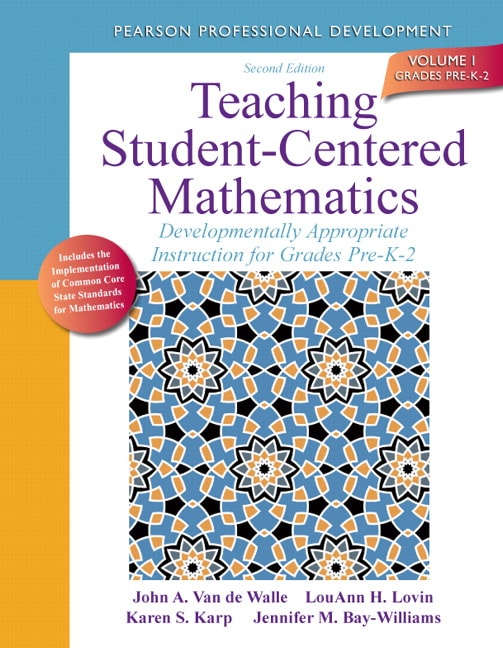
"To conceptualize a number as being made up of two or more parts is the most important relationship that can be developed about numbers." (Van deWalle 2006, pg 26)
This was such a great quote that helped me make the connection that composing and decomposing is the conceptualized foundation that helps support students understanding for addition and subtraction.
So bottom line is composing and decomposing is NOT addition and subtract, but it lays the foundation for students being able to fluently add and subtract, mentally!
Watch this video:
Wednesday, April 18, 2018
Does McDonald's Sell Cheeseburgers? Well,...does it?
Of course McDonald's serve cheeseburgers- what kind of question is that right?

I mean isn't this the thief we are referring to?

Or perhaps THIS is the thief that we should really be addressing. I must raise my hand and be the first one to admit that I was the preacher for this riddle/rhyme when teaching my students long division. I cared not about students' frustration with learning acronyms, giving them steps that had no real mathematical meaning and thus robbing them of whole number- number sense and more importantly robbing them of the true meaning of division! For me, the vocabulary for this unit was:
I mean isn't this the thief we are referring to?
Or perhaps THIS is the thief that we should really be addressing. I must raise my hand and be the first one to admit that I was the preacher for this riddle/rhyme when teaching my students long division. I cared not about students' frustration with learning acronyms, giving them steps that had no real mathematical meaning and thus robbing them of whole number- number sense and more importantly robbing them of the true meaning of division! For me, the vocabulary for this unit was:
- Outside number
- Inside Number
- Number on top
- Divide
- Multiply
- Subtract
- Bring Down
- Check
- Answer
Did you count the true academic vocabulary in that list? I did not hold my students accountable for academic vocabulary, mathematical thinking nor articulation of repeated subtraction with efficient methods.
Research says that division isn't only similar to subtraction in that it involves the separating mechanics, but that it is (just like subtraction) a difficult concept to grasp for students. And difficult concepts should NOT be approached, tackled nor attempted with abstract methods. If not all concepts, those which are most complex should be gradually approached with concrete manipulatives and connection to pictorial representations. Consistency in practice should take place at these levels before we make the connection to a more abstract algorithmic method.
So I share this video (based on approaches that I've read are more developmentally appropriate for students) and I wish I would have used when I was a classroom teacher. Now, I get chances to work with students in small groups and I claw at every chance I get to expose them to these strategies and raise the level (bar) of mental math for them. After all, students can learn at high levels if we simply embrace those methods and take the risk of exposing them to those strategies! Will you try it?
Friday, April 13, 2018
To Coach...or not to Coach?

Serving as an Instructional Coach can be a very daunting and overwhelming task. It can also be varied and uncertain in terms of tasks and expectations. Have you ever heard that joke about the "fine print at the bottom of a contract"? If any position in Education relates to this joke, it's that of an Instructional Coach (or Specialist).
A colleague came to me not long ago and expressed their interest in returning to the classroom from their time as an Instructional Coach. I must say, having spent some time investing in this colleague as a mentor, I was a bit devastated.

So I asked this colleague why they were considering returning to the classroom (which there is NOT a law against, by the way). Their response to me was that their true passion lies in working directly with kids and that they miss the classroom. Now, at face value, I took the response to mean that they had this aching desire to be in the classroom where they felt they could have the biggest impact! Few words/ideals are more true than that and I wouldn't dare fight such a theory and noble desire.
But after some thoughtful consideration, I mauled over their statement and proceeded to dig a bit deeper. Could this person mean by "they miss the classroom", that they feel as if they don't get enough time in the classroom? So after a series of probing questions, I hit gold! They were trying to articulate that the position of a Specialist/Coach was super overwhelming and inundated with so many other tasks that being where teachers needed them (modeling and supporting kids) was near impossible.

But I learned that some things needed to happen "off the clock" and I needed to MAKE TIME for teachers. So I organized my schedule by placing priority on a specific few grade levels (supporting K-6 meant I needed to pick both a testing and primary grade to focus on).

1. After my PLC and planning times were set, I put my office hours during the lunch block (11am-1pm) and filled everything else in with classroom time!
2. When I sat in daytime (45 min) planning with teams, I looked for opportunities to come into their classes to support and model. If I heard them talk about not knowing how to approach something, after I gave an example, I followed my spill with "I can come in and model or co-teach"! This statement probably won me the MOST time invited into classrooms.
3. Sitting in PLCs discussing data were prime opportunities to invite myself into classrooms! Once a teacher inevitably asked, "how can I reteach this?..." I found my window of opportunity and put them on my schedule!

4. While observing in classrooms, rather than standing at the back taking notes, I sat with kids and helped them. I engaged in the classroom learning as if I was a student. This way when the teacher stopped me later and asked what I thought...I found a way to ask if they needed me to support them with anything- another window to slide into classrooms!
5. After each co-teach and modeled lessons, I made it a priority to follow up with the teacher and consistently ask, "Let me know if you need me to come in and help!"
6. Offering to stay after school with them to help them look up resources and flush out their lesson plans!
These practices, along with building relationships with teachers: eating lunch with them (although I'm an introvert and prefer time to myself or was busy and had other things to do), and chatting with them after school while they planned all conspired to build trust and before long I was invited to classes (rather than inviting myself).

So yes, there are 99 problems in Instructional Coaching, but getting into classrooms and working WITH teachers, should NOT be one of them! It should be a front burner priority. It is how we impact learning and make footprints in best practices. The desire to "BE IN THE CLASSROOM" should never die out. It should be the motivating factor for Instructional Coaches and Administrators alike. If we ever lose the hunch and drive to be in a classroom (after we've taken a different role than teacher) then we've forgotten why education is important. Now, while I personally don't believe climbing the "corporate" ladder should be a mindset for Educators, I do understand (and don't "shade" people for trying to financially improve - we all know Educators are the catfish of salaries). But there's so much more reward in the touching of lives, that I feel our focus should be pursuing what we are passionate about and gifted in. It should be about impacting more teachers and students with best pedagogical practices with the intent to stay as close to the classroom as possible.

As a District Math Program Coordinator, not much has changed. Going from serving 20-24 teachers to now 32 campuses (roughly 800 teachers), the mindset has to be the same. My plate is not only full, it looks like a buffet overflowing with food. But I make it my purpose to set aside a day a week to be on campuses, showing my face in classes, highlighting the wonderful things our dedicated teachers do everyday and looking for open doors to be in PLCs, planning and/or classrooms by invitation. I still get that tingly feeling when a teacher sees me in their class, and invites me to join in the lesson. No greater joy than working with kids and gathering authentic data to not only continue my growth as a lead learner but to make ripples in the lives of Educators and students alike!
"I got 99 problems (things to do) ...
...but being in classrooms AIN'T one of them!"

Tuesday, April 3, 2018
Hyped over Hyperdocs!
So one of our District Goals this year was to provide Review Resources to our teachers so they could focus more on having collaborative discussions around their data and creating their instructional lessons to align to the standards. So as I fumbled over the first few modalities I would use to send this MASS REVIEW resource out to teachers, I stumbled across this amazing website!

It gives samples of Hyperdocs (a google doc on steroids with hyperlinks to various resources) created by teachers for various subjects. I grew particularly fond of this one Hyperdoc Game board template and began to play around with it.
6 months later, I have a compilation of various Benchmark & STAAR review Hyperdocs created for teacher clickable ease!
Check them out!

It gives samples of Hyperdocs (a google doc on steroids with hyperlinks to various resources) created by teachers for various subjects. I grew particularly fond of this one Hyperdoc Game board template and began to play around with it.

6 months later, I have a compilation of various Benchmark & STAAR review Hyperdocs created for teacher clickable ease!
Check them out!
Thursday, March 8, 2018
Facts or Fractions?
Lately I've had this re-occurring question pop up and not far behind has been it's coupled demand...
Question:
"Shouldn't students have a good grasp on multiplication facts before they manipulate with fractions?"
Demand:
"We need to put Multiplication/Division unit before the Fraction unit in the Scope and Sequence. It makes sense that students need to master their facts before they work with fractions!"
I beg to differ and here's why:
3.3F (Equivalent Fractions) TEXAS standard says students are to...
"Represent equivalent fractions with denominators of 2, 3, 4, 6 and 8 using a variety of objects and pictorial models, including number lines."
If we isolate the content (equivalent fractions) from the WHAT or skills students are to do (represent) we get a very concrete and representational approach to instruction.
The CRA (concrete-representational-abstract) process is evident in the progression from 3rd to 4th grade.
Check out the verb difference...
3.3F - Represent...
4.3C - Determine...if two given fractions are equivalent using a variety of methods.
Do you see the progression? Third grade is the place to develop "Fraction Sense" (conceptual and visual foundation of breaking fractions in half) through the lens of the concrete and representational lens. Fourth grade is the place to make connections and build on their fraction sense by using abstract methods to find equivalent fractions.
So perhaps we use 3rd grade as a training ground for exploring with manipulatives and creating visual mental pictures of how to break fractions in half; leaving students with an ability to find methods that make "fraction sense" when they get to 4th!
I do resolve that Multiplication should precede Fractions but so that students have a longer "school year" to master their facts, NOT for the purpose of using the knowledge to master fraction equivalencies.
Here's a quick video to clarify!
Wednesday, February 7, 2018
Instructional Nourishment
What was the last meal you had? What all did it consist of?
Better yet, can you give an account for the last three meals you've had (breakfast, lunch and dinner)?


How silly, right!? Because supplements are meant to take up for where the planned, well-balanced meals might fall short in terms of nutrients. They're the back up plan when your Plan A happens to be missing some critical components. And even in their use, they're not intended to be consumed continuously in place of food, unless you're physically unable to intake the foods that contain those essential nutrients.

Teachers, a guaranteed viable curriculum is the critical component in Tier 1 or Initial instruction for students. A guaranteed viable curriculum is comprised of a healthy knowledge (depth and breadth) of the standards and content you are tasked with facilitating learning around. It involves a healthy balance of backwards design in planning out lesson approaches (rigorous formative assessments), low floor, high ceiling tasks that engage and hook students and peak their interests, hands-on math tasks that encourage exploration and evoke questions while promoting visual stimulation. It's a class full of peer to peer discourse and movement, students testing their theories and learning from their mistakes. It's students receiving small group support or one-on-one conferencing to adjust their goals. It's students eagerly anticipating the stations their teacher has so diligently prepared so they can independently or collectively explore their own ideals about math. When a teacher takes this type of approach to their initial instruction, they are providing a well-balanced instructional meal to their students.

Let's nourish our students by showing them we are willing to plan out instructional meals that will make them want to feast at the table of learning and leave the supplements on the shelves.

Subscribe to:
Posts (Atom)