Friday, July 31, 2015

Stop, drop and PIN!

Picture this: It's Saturday night and your lesson plans are due by Monday morning (if you're truly a teacher, you'll know this is really fictitious). So you open up your online planner and with intense excitement you minimize your screen and click on your bookmarked icon. You know the one...


After all, you just attended an amazing Math conference that had an hour long session dedicated strictly towards Pinning classroom ideas and networking with virtual teachers for some quick grabs! You head over to your Math classroom board to sift through your recent pins for a cute lesson that will engage your kids (keep them busy) and amaze your administrators (make them believe you're on top of your game) once the product is hanging on your bulletin board!
You cut and paste the "activity" in your planner and scroll your mouse over the SUBMIT button...but

WAIT!! STOP!! 
Step away from the button...

My friend, you are about to make a huge mistake. We are greatly privileged to be in one of the few professions where stealing is accepted rather than frowned upon. Yes, our livelyhood can easily be viewed as the practice by which plagerism (to a degree) isn't unlawful! Meaning yes, you are handed down creatively designed activities and sometimes at a rip off price ( thanks to heavenly sites such as Teacherpayteachers.com) but nevertheless they are pre-made and ready to implement! But you have forgotten the most critical component of planning...the goal!

Whether you're a freshman to teaching, still getting your sophomore/junior year credits up or cruising your super senior years, the following components are essential to your Pinterest success!

STOP!
1. Study your standards: Know them, what they mean and to what extent they must be taught. Utilize sites such as lead4ward to access, and download your grade level TEKS at a glance.

For example: K.2E states to generate a set of concrete models or draw a pictorial model that represents more than, less than or equal to a number (up to 20).

This lets you know that students (under no circumstance, even those advanced and gifted) should practice this skill beyond 20. The skill can be modified to be tougher (such as creating figuring out how much more or less or creating multiple numbers) but should not be pushed beyond 20.

DROP!
2. Facilitate an engaging mini-lesson! Remember YOU are the teacher, NOT Pinterest! Dr. Nicki Newton (author of "Guided Math in Action") says " you might teach the students a song"... (about more and less), you may "read a picture book, play a game or read a poem related to the topic". Get the Big Idea rolling and even create (as a class) a math anchor chart that students can reference later.

Utilize your curriculum and expertise as well as any additional curriculum resources. For example, you might consider displaying a dot card and have students place the same number of counters on their desk as is reflected in the dot card to emphasize " same" and discuss synonymous vocabulary such as "equal to". Next, you may ask them how to demonstrate more (greater than) and less (than) in relation to this amount and justify their answer. Discourse between you and the students as well as between students and their peers is critical at this stage.

PIN!
3. Now it's Pinterest time!! Pull out those manipulatives and search Pinterest for some activities that help drive the concept home! Don't be fooled though, utlitzing Pinterest activities take much thought in and of themselves. Should they be placed in a center? If so, when/how will I model how to use the center? What manipulative should I use? How will I differentiate the activity so users at different levels (novice, emergent, expert learners) can be challenged?

I'd be remiss if I didn't mention that a thoughtful pre-assessment (whether formal or informal) is imperative prior to planning. Knowing where your kids are and what they need drive this entire process! 

Take away? Pinterest is never the engine...its the caboose! Pinterest isnt the goal, its a tool that helps us reach goals! Pinterest should always serve as the icing on the cake. It should never replace the cake or play the role of the much needed ingredients used to compose the cake. Pinterest can be a powerful tool, so don't let anyone take that away from you or discourage you from its use. But be an educated user of the tool, otherwise it will waste your kids time and leave you frustrated!

Happy planning!! 


Monday, June 29, 2015

"I don't get it!"

Now I consider myself a person with a very high tolerance level but when I'm in the classroom, I find that few things are tolerable to me and one of them is the cop-out phrase "I don't get it!" You may think that's unacceptable for a teacher to hate the typical 'cry-for-help' phrase, but hear me out.

I always challenge my students to think positively rather than negatively. So I set up a standard at the beginning of the year. I suggest that we use the phrase, "Could you help me understand?" in place of "I don't get it!" Why? Well one phrase is often used to justify why they've given up. While the other suggests that I'm not willing to give up, if you can show me another way, I want to "get it".

Today, my (intervention) small group had a silent "I don't get it" moment. Let me set the stage for you:

So you've taught your whole group lesson on Perimeter and Area, fully equipped with hands on models, foldables and pair-share thinking questions. All of this lasted its full 30-45 minute time (since you're a 5th grade teacher and these concepts are review anyways).
Now you're in small groups with your 4-5 students and you're diving deeper into the concept. You come upon a problem that is a bit more rigorous and your goal is to hammer through it piece by piece via open discussion.

The problem goes like this:

Ms. Kim has a backyard with the dimensions 60ft by 40 ft. She has a flower garden in the corner of her backyard with the dimensions 15ft by 20ft. How much of Ms. Kim's backyard does NOT include her flower garden?

What do you do?

Let me share with you my journey through this rigorous discussion. To me this was the easier of the two questions I wanted to discuss. Based on the level of these students at my table, I was not shocked by their blank stares. My students were mentally numb and no matter of discussion was bringing forth a solution for this problem. So of course the obvious move was to switch into "INTERVENTION" mode and help students understand:

A. What the problem was asking us to do (find the grassy part of the backyard (minus the garden)).

B. Figure out a process by which to calculate this leftover section.

C. Chart out all of the steps (in correct order)...utilizing their Math Reference (STAAR) charts.

The discussion was quite toilsome. Below is the approach we took.

1. We looked at a piece of rectangular construction paper.

I asked "How does this piece of paper represent our backyard?"


2. Then we analyzed the problem by re-reading and pulling out components like "does NOT include her flower garden" that need interpreting. Using the construction paper, we drew a section to represent the garden and asked,

"What should we do to isolate the garden from the yard?"
STUDENT RESPONSE: Cut it off!!!

So we did. Then we discussed what the left over represents.
STUDENT RESPONSE: The part of the backyard that is NOT the garden.

3. We went back to the problem to make a connection.

"How do we demonstrate using math language, cutting the garden away from the backyard?"
STUDENT RESPONSE: Subtraction!!!

"Subtract what?", I followed up!
STUDENTS RESPONSE: Subtract the garden (area) from the backyard (area).

From here, we were able to decide what formula we needed.

Area (rectangular backyard) - Area (rectangular garden) = Area (leftover backyard)
 
I had students identify what formula they would use and justify why!
*This was very important with the smaller rectangle, because some of them thought we would use the AREA (square) formula simply because it LOOKED LIKE a square.
 
"What do we know about the sides of a square?", I asked. (That they are all the same)
"Are the sides of the garden the same?" (no)
"So what can we conclude?" (its a rectangle)
 
-------------------------------------------------------------------------------------------------------------------------
 
The next problem was even tougher for them to think through. But I could be a bit more understanding. Here's what it looked like:
 
A rectangular wall had a window in the middle of it. How will you determine the area of the window?
 
 
I wasn't even mad at one of my students who said, "Get a ruler and measure it!!"
That's the logical think to do, right? She got my vote but I'm sure everyone else at the table was mad when I shot down her idea with my response, "We would totally do that if they instructed us to use a ruler to measure it, but since they didn't, what other method should we use?"
 
No amount of THINK TIME was helping these students figure out a solution. So we took to a hands-on model to get their juices flowing.
 
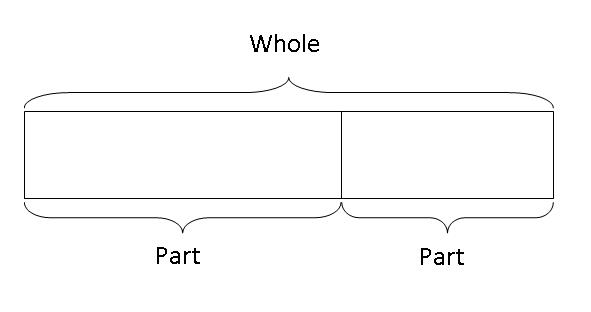
So we used a series of linking cubes and a part-part-whole mat. I asked them to identify the "whole" from the linking cubes.
 
Then I related the linking cubes to the length of the wall. I had the students discuss how we could separate the yellow section (the part) from the purple section.


STUDENT RESPONSE: Cut off two purple ends!!
*and we did!
 
We translated our actions into a mathematical number sentence:
 
Whole - part = part
 
From here they were able to see the length of the wall as the "whole" and the window as the part that needed to be separated.
 
They discussed as a table, that they should:
 
A. Subtract 7 from 20, then subtract 7 again to find a leftover of 6. (20 - 7 - 7 = 6)
 
Then someone said, "Couldn't we just..."
 
B. Subtract 20 - 14?
 
So I posed their question to the group to vote! The we justified why these two approaches were similar.
 
Finally, the students were able to ascertain the length of the window. Now, in the original problem, the window was a square, so we were essentially done.
 
We labeled the lengths and widths of the square and calculated the Area of the window.
 
One young lady said, "why did they give us all that information if all they wanted us to do was find the area of the window?"
 
After we all had a good chuckle from her pertinent question, a student replied, "Because it was the information we needed to find the information we didn't have!"
 
WOW!!! What a learning moment! Now, could I expect them to do problems like this on their own? Not for this small group, but with more practice, they would eventually grasp the idea.

Here's the take-away. Don't expect all of your students to apply perimeter and area immediately! Students with slower processing skills need a more concrete association as they think through word problems. Be patient and open enough to build the bridge to their understandings.

My philosophy is, "Your light bulb may not go off when others' go off, but it WILL go off!"


Sunday, June 28, 2015

When Teaching gets Frustrating...

Have you ever been standing at your dry erase board waiting for the class to give the answer to your math question? Waiting, in the intolerable silence; begging them by rehearsing the question in different ways almost literally giving away the answer. Not even your usual 'quick arm shooters' have their hands raised. You feel your blood boiling and you're moments away from giving up.

Later, in your small group you are asking students to decompose a number and the 5 students are sitting with linking cubes in front of them yet starring at you like a deer caught in headlights. Finally, you scream, in frustration, "COME ON GUYS, DE.COMP.OSE THIS NUMBER!!!!!!!!", as if that will somehow provoke them to spew out the right answer.

Yes, teaching (imparting knowledge into someone's brain) can be difficult and even frustrating. But when you're facilitating learning, the process is a bit more meticulous. Let's explore the process:

Let's say you ask your students to explain to you how they can mentally add $19 + $28.

1. First let's analyze the question I presented. I didn't start the lesson by telling them that we would learn how to add these two numbers. Rather I had them explain to me what they THINK they could do to add these two numbers without pencil and paper.

My objective (later) is to teach them the algorithm, but not without asking them to draw on their prior knowledge (hopefully of base ten and/or decomposing numbers, making ten, counting on, etc.). The idea is that I want them to explore the various strategies they may already be aware of.

2. After hearing their explanations (and hopefully you gave them opportunity to discuss with a partner or table of students so they can draw on the thinking of other students), you want them to share out. This allows you, THE FACILITATOR, to both correct their thinking and informally assess where they are.

If this step isn't taken seriously and intentionally planned, frustration can easily enter. You must KEEP CALM and allow various incorrect approaches!

3. Most importantly, you must be prepared for these incorrect approaches (answers). They must be premeditated. In other words, you should know all the responses that will be given and be ready for them. Yes, especially the incorrect ones!

So really, step 3 is pre-step 1! When you're lesson planning, you must think of how you will handle the responses-what intervention will be needed? You must think through how you will group your students based on their responses.

This step involves intervention planning (intervening when strategies aren't working).

A. If the students started at one and counted to nineteen then added 28 more...DON'T FUSS!!! This simply tells you that the students struggle with COUNTING ON and REASONING.

B. If the students counted on from 19...CELEBRATE THEM! That wasn't the best strategy but at
least you know they can SEQUENCE and COUNT ON! Their next step then is to help them apply UNITIZING and CONSERVATION of numbers.

C. If the students are able to decompose the 19 into 1 ten and 9 ones ...then decompose the 28 into 2 tens and 8 ones for a combination of 3 tens and 17 ones--well they are in a different and more advanced place! They may not know how to regroup the 17 ones but at least they understand DECOMPOSING!

*There are other answers that you could expect, such as:
MAKE TEN STRATEGY

Taking a "one" from the 28 and adding it to the 19 to make 20 (this is called the MAKE TEN strategy). This would restructure the problem to 20 + 27. Regrouping, then wouldn't be necessary.

The idea is to cut down on frustration on your part, by understanding the various places your students can and may be in their level of development. This can occur by reading articles on Numerical Development such as Subitizing by Douglas Clemens, 1999. You may also check out Teaching Student Centered Math by John Van de Walle.

Be prepared to take them to the NEXT level in their cognitive development.

"The best defense is a good offense!"

"Be proactive, rather than reactive!"

Monday, May 18, 2015

Where's the Value in Place Value?

I have a love-hate relationship with the New Math TEKS, as I'm sure many of you Math Educators can probably understand. Although, if I truly took your pulse, I'm willing to bet 'hate' would be the more dominant beat than love.

Well I love that the TEKS address the foundational and conceptual basis of Math (which in fact are NOT new at all, just new to us). I hate that there are little to no resources that really instruct teachers on how to disseminate the information to their students. But with the latter, I find it fun (call it the geek in me) to study different strategies and create in my mind the perfect classroom situation and centers for students to engage in to assist with their discovery of these understandings.

Big shout out to my 3rd grade teachers who are now helping students understand value of numbers to the hundred thousands place. Here's a few strategy and center ideas to help you out next school year! And if you happen to teach 4th grade, you may benefit from this as well.

The NEW TEK states:
3.2A (similar 4th grade TEK is 4.2A) -  Compose and decompose numbers up to 100,000 as a sum of so many ten thousands, so many thousands, so many hundreds, so many tens and so many ones using objects, pictorial models, and numbers, including expanded notation as appropriate.

3.2B (similar 4th grade TEK is 4.2B)- Describe the mathematical relationships found in the base-10 place value system through the hundred thousands place.

*Note the only difference in the 3rd and 4th grade TEKS are verbs and the place value focus.

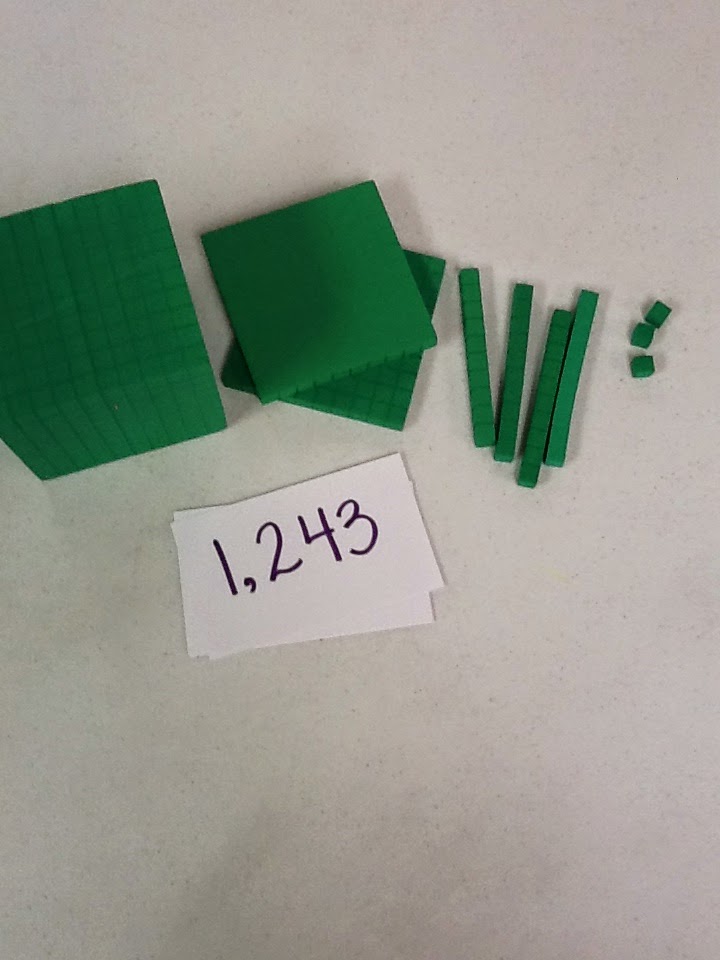
STRATEGY IDEA: So, during your 15-20 minute mini-lesson, have your students sit in cooperative groups and work with a set of Base Ten Blocks (distribute up to 1 thousand block, 3 hundred flats, 5 ten longs and 10 units per group/pair-this should help you keep the numbers you compose/decompose within a certain range).

1. Give your students the task of creating a ten long using only unit cubes. Have them verbally express how we could write this in a number sentence. [They may say 1 + 1 + 1... = 10] Assist them in creating a multiplication number sentence (because up to this point they've only covered multiplication in the contextual sense, the multiplication symbol hasn't been introduced formally).


Verbal sentence: "1 group of 10 units = a 10 long" 
Number sentence: 1 x 10 = 10
 
 
2. Repeat facilitation of this task by having them line up the ten longs to see how many it takes to create a hundred flat; how many hundred flats stacked create a thousand block. Again, have them create a verbal sentence and corresponding number sentence.
 
3. Students can have a place value chart drawn in their journals. They can draw an arrow from the ones place to the tens place and label the arrow "10 times". Then draw an arrow from the tens place to the hundreds place labeled "10 times" and so on; to show that the progression from right to left across the place value chart is based on multiples of 10. Allow them to extend the pattern to the hundred thousands place.
 
 
4. Finally, demonstrate how to build a number (such as 324) and trade one of the hundred flats for 10 ten longs. Have them count to see if the value remains the same:
 
Say: "One hundred, two hundred, two hundred ten, twenty, thirty..., three hundred, three hundred ten, three hundred twenty, three hundred twenty-one, ....three hundred twenty-four)."
 
*This will help them grasp the concept of 'regrouping' when subtraction!!!
 
**Then see if they can discover other relationships; can they determine a relationship between the units and the hundred flat?
 
Verbal sentence: "10 groups of 10 units = a 100 flat"
Number sentence: 10 x 10 = 100
 
 
CENTER IDEA:
Materials: Number generators (dice), index cards with different numbers written on them, Place value disks.
 
 
Create numbers on index cards (or let students generate numbers using dice) in standard form up to the hundred thousand place. Have students build that number using place value disks or place value blocks.


Students can then write the number in expanded notation.
(1 x 1,000) + (2 x 100) + (4 x 10) + 3 x 1)
 
What many don't know is that the standard implies that students must be able to represent the number in other ways. So have students trade out a place value (for its x 10 value equivalent) and rewrite the same numeral a different way.
 
 
Notice here how the thousand block has been traded for 10 hundred flats.
This makes a combination (total) of 12 (10 and 2) hundred flats.
So the new expanded form & notation, respectively, would be as follows:
 12 hundreds + 4 tens + 3 ones
(12 x 100) + (4 x 10) + (3 x 1)

 
OR
 
Notice here how one of the ten longs has been traded for 10 units.
This makes for a combination of 13 total units, which doesn't change the value of the number but does affect how its written:
1 thousand + 2 hundreds + 3 tens + 13 ones
(1 x 1,000) + (2 x 100) + (3 x 10) + (13 x 1)
 
 
Now ordinarily, I would advise one to use a center sheet so students can record their findings. Something like what you see below (but of course for larger numbers):


No disrespect for those types of sheets, I often use them! But I'm a bit of a "tree hugger" (I like to protect the number of copies I make) so I prefer dry erase boards (unless of course I'm collecting it for a grade). Then in that case, I would put to use the construction paper in my room and have students create a foldable and record their work on it, in chart form.
 

Can't wait for the Fall to roll around again so you guys can try this out and let me know how it works for your students! Happy Educating!


Thursday, May 14, 2015

Trick or Strategy?


I remember being in the classroom and prior to beginning a new unit, I would typically have a "pow wow" with my students about what we were about to learn and how it would be useful in their practical lives. As we entered the fraction unit and discussed how to compare fractions, I would always have a students shoot their hand up and yell out "I know! We can "Cross Multiply!"


And each time, my skin would crawl as my Cruella DeVille would rise up and say "No, we will NOT!" I would be infuriated that the kid wanted to use some lame trick to compare fractions." But I soon realized I couldn't be upset at the student. It was the 4th grade teacher I needed to spit venom at. They were making us 5th grade teachers work harder (we had to break the old, bad habit then teach a new habit) when really we should have been teaching the concept from a clean slate (or at least building on a foundational fraction concept).


Does "Cross Multiplication" work? Absolutely! But what does it really represent?
If students could not find a common denominator to turn both fractions into equivalencies, they could easily multiply the two denominators together (In the example above, they would get 75).
Then the numerator of both fractions, respectively, would be the product results of cross-multiplication. But this is a bit advanced for 3rd and 4th graders.

So what happens when teachers teach "Tricks" like "Cross Multiplication" is students lose conceptual understanding essential to their development in mathematical learning. They learn a trick but have no understanding of the "why" behind its' process. In actuality, they learn to be lazy and settle for a drive-thru junk food meals for a quick fix rather than wait for and feast on a home-cooked meal that won't only satisfy their craving, but provide nutritional value.

So what's the remedy? Learn the foundation for concepts yourself (even if it seems new to you).

First let's look at foundational progression of fractions.

Watch the progression:
3rd Grade- 3.3H "Compare two fractions having the same numerator or denominator in problems by reasoning about their sizes and justifying the conclusion using symbols, words, objects, and pictorial models.

4th Grade- 4.3D "Compare two fractions with different numerators and different denominators and represent the comparison using the symbols >, =, <.

Prior to the NEW TEKS this TEK progression applied to 4th and 5th grade, respectively.

 Students can understand fractions on a number line by relating Fraction tiles to number lines. Why? Because in previous grades (even in 3rd grade), the standard encourages open play with fraction tiles! LET.YOUR.STUDENTS.EXPLORE! Take the manipulatives off the shelves and let them build and create and make connections. They're capable!


Once students have grasped that (for example) three-thirds is equivalent to one whole they should be able to see and understand that one-third is close to zero, while two-thirds is closer to one whole. This leads to the understanding of "benchmark fractions"


Benchmark fractions can be seen and taught fairly quickly. Once students know 0, 1/2 (and its equivalencies) and 1 on a number line, they can justify which fractions are closer to zero, which are closer to half and those which are closer to 1 whole. This is more than half way to the learning expectation!!!

*Coach's note: What I would do is have my students build a blank number line. Then take a fraction tile (such as a fourth) off the tray and place it on the number line close to zero. Have them make a tick mark where the 1/4th tile ends. Continue this pattern until you reach 4/4ths = 1 whole.

Using the Number line as a basis, comparing then becomes feasible because students can plot two fractions on a number line or compare them both to benchmarks (five-sixths) would be closer to one whole (six-sixths) which is larger than, say, five-eighths because 5/8 is closer to four-eighths or one half.

Coincidentally, once students understand that the larger the denominator, the small the fractional piece (through exploration)...and vice versa, they will begin to compare fractions easily. They can justify that three-eighths is 3 small pieces, while one-half is 1 large very piece so one half MUST BE larger than three-eighths.

Now THAT'S strategy! And though it takes some doing (or developing) to get students to this point, their understanding goes a long way.

Ever wonder how students will use "cross multiplication" when they must compare (or "order" is the mathematical SE verb) three or more fractions? That's how you know the "Trick" you taught them, was unreliable.

Wednesday, April 22, 2015

STAAR is over...now what!?

Before you bring out the wine and pop bottles in triumphant celebration of making it through the week of testing, put your glass down and step away from the spirits.


I know, I know...you worked hard all year teaching your students concepts,strategies, how to use their reference chart and graph paper. You've labored over training students on pacing themselves and processing through rigorous word problems. You've fought the endless battle of "show your thinking" and wrestled with them on how important knowing their facts is to their ability to work problems with fluency. All to face this handful of boring days of 'actively monitoring', secretly hoping and praying they've listened to you and applied all those lessons! As the testing days end, you're as exhausted and nervous as they are and you did nothing but read lines from a testing administrators book and move around the room to ensure students were on task.


You deserve a break, right? After all, the curriculum has been tested and you did all you could do! The end is nigh!! So what about these final 6 weeks of school? What are they for? Recuperation it seems. I don't mean to throw salt in your bubbly, but you might want to consider a few things before you propose a toast.


1. Assessments aren't the end all-be all:
As educators, our commitment is to just that, education. Education doesn't merely begin nor end with an assessment. Assessments are an on-going evaluation that measure progress and prepare us for the next phase of learning. An effective teacher typically pre-assesses their kids in hopes to reveal what needs to be taught in the concept. Quizzes often serve as a midpoint measuring tool both for the student and teacher. Immediately following the concept, the teacher gives an assessment to chart growth. And the cycle repeats for each concept. But in the next unit, the teacher revisits the concepts from the previous unit and a best practice is including concepts on the new test, that the students didn't master from the test before.

2. Instructional days imply instruction:
A school calendar has at least 180 instructional days built in. Testing generally occurs by what?...like the 150th day or so, of those instructional days? Leaving roughly 30 instructional days remaining. The operative word here is 'instructional'. This calendar sets our standard to instruct students for the totality of 180 days and as we commit to our profession of teaching. our goal should follow suit.


3. Teach the child, not the test
I've heard of districts supporting the ideal of  'teaching to the test', justifying their beliefs with the claims that teachers are assessed based on how students perform. But, in my mind, there are cracks in that line of thinking. A teachers' salary, first of all, is way too low for their performance and worth to be determined merely by some scores on a test. A true teacher is passionate about the growth and progress of their students. Yes, we may have a particular craving for one subject matter over others, but when you watch a true teacher in action...you see more than someone drilling and killing strategies. You see deeper things occurring than just small group and center based instruction. You see engagement because the teacher has built repor and respect amongst their students. You see buy in from students who have grown accustomed to the safe culture of a classroom environment, all set by the teacher. You witness students who have learned to trust that their teacher believes in them, wants the best for them, and won't give up on them. And from this, students will perform at their best. No test can assess these things.

Finally, know this...curriculum never ends. Student must be prepared for rigor, depth of thinking, processing skills, and application of concepts. Post-testing, is the perfect time to repetitiously embed these skills because they will be used as the child is exposed to higher concepts in the next grade level. Those 30 stress-free days remaining give you the flexibility to review, remediate and grind those concepts home in a creative way. Now imagine the student looking back in years to come and appreciating the fact that they can understand their current content simply because their teacher never

gave up teaching after the STAAR. This powerful act confirms that their teachers' job was never about some test, it was about the passion they have for their craft.


Now, I will drink to that!

Sunday, February 8, 2015

Measurement Match It!

One of the the most powerful techniques to use in teaching is student prior knowledge through discourse and facilitation of learning. Below is a mini-lesson that can be facilitated by 4th grade teachers to introduce the following Student Expectation.

"Identify relative sizes of measurement units within the customary and metric systems." 4.8A


First lets look at the implication of the SE's verb.

Identify: this suggests that students simply need a point of reference to select from as it pertains to length, mass and volume.

Now, this SE is one that supports a readiness expectation wherein students must be able to solve problems in measurement that deal with conversion. In order to convert, however, students have to have a point of reference to help them know whether they are converting a larger unit into a smaller one and vice versa!

Materials: sentence strips, pictures of real life items, chart paper per group, markers per group

Facilitation Procedures:

1. With your students sitting in cooperative groups, distribute a sentence strip paper representing a source of measurement (length, mass, volume (in the customary or metric system) and a series of pictures that relate to each unit within that system. Give each group a different strip.


2. Have groups talk about which pictures match with which units. Encourage students to justify their answers with each other.

3. Once groups have matched each picture with its unit, have students record on their chart paper their reason for each match (with their marker).


4. Allow groups to get up, and rotate to another groups' table and analyze/critique their answers. Using a marker of a different color, encourage the group to either add their own justifications or change that groups answers and justify why.


5. Continue this rotation until all groups have visited each table and had a chance to discuss, analzye and prove (adjust) each of the systems of measurement.

The pictures for this activity can be found on the following website/blog site:

"Measurement Charts" are the freebies she provides!

This mini-lesson activity is great right before allowing students to break into their stations or centers and at your small group table it would be beneficial to help students underand this concept futher by facilitating deeper discussions and providing hands on exeriences like the following:

"Would the mass of a penny be best described as 4mg, 2.5mg or 0.5mg?" Then allowing students to measure (hands-on) that penny and justify why.

This type of exposure can be powerful in a station as well.